
The Horsham Property Market in July 2026
A summer of abundant choice, careful buyers and the widening distance between hope and reality There is a particular rhythm to Horsham i...


What a 24 hours it has been for the UK property market!
Inflation hit a three-year low of 2.3%, the annual price change for a property in the UK was up 0.7%, a cut on the base rate was on the cards for June, and there was a renewed positivity in the air.
However, this positivity turned to uncertainty when Rishi Sunak called a snap election for 4th July.
The impending general election adds another layer of complexity to an already complex property market.
Political campaigns and elections historically create uncertainty and this influences market
sentiment and investor confidence.
Because of this, I’m going to be looking back at what previous elections have meant for the UK property market, what we can expect to happen in the lead up to the July election and the months ahead.
A general election can have a significant impact on the property market, influenced by the policies of the competing parties, the stability of the political climate, and the general economic outlook.
Here are some key ways in which a general election might impact the UK and Horsham property market:
Not so long ago, the uncertainty created by general elections would cause many households to put on hold a decision to move.
However, have the past decade’s political ups and downs, including Brexit and the pandemic, made people slightly more comfortable with uncertainty?
The number of properties for sale, new listings entering the market, and sales agreed are all up in the first four months of 2024 compared to 2023 and the six-year average.
A survey conducted by Savills in April highlighted that 79% of respondents moving plans in the next 12 months were unaffected by the prospect of a general election, with 13% more committed, and only 8% less committed.
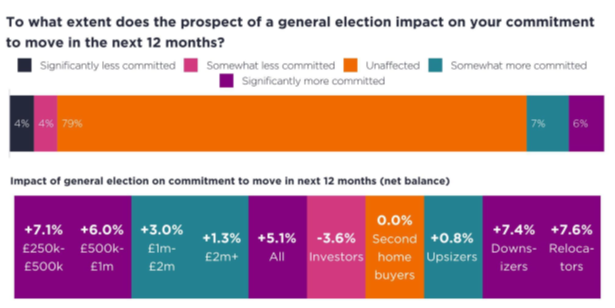
With the above data, the answer appears to be a resounding yes and that people have changed from a wait and see approach to a just get on with it approach.
Over the past decade, major political or economic events have had less impact on prices and transactions than has been the pattern in the past.
The main reason why the general election has not impacted the commitment of those looking to move over the next 12 months is the stance of the two main parties.
Whilst at present, the odds may suggest a new Prime Minister at 10 Downing Street, the current leaders of the two main parties are not a million miles apart with both pitching strongly for the centre ground, and this limits the likelihood of radical change.
For a general election to have a major impact on the property market the outcome would need to raise the possibility of material change in the macroeconomic backdrop, direct housing or property taxation. Often that isn’t the case.
Any change of government is more likely to be felt at the upper end of the market, where there could be a threat of more taxation and where discretionary moves tend to be confidence driven.
A Labour victory appears the most likely outcome and while it has ruled out introducing rent controls or wealth tax, other measures could dampen demand in prime property markets.
These proposals include overhauling the non-dom tax regime, increasing the 2% stamp duty surcharge for overseas buyers, adding VAT to school fees, and changing inheritance tax rules.
Sound economics is likely to be a central theme of both parties’ general election manifestos.
If the election is fought on the centre ground and mortgage rates begin to fall, this should mean an increase in the number of transactions.
On the assumption that there are no further significant shocks to the economy, the gradual decline in mortgage rates should encourage more households to plan a move, kickstarting the beginning of a recovery.
There has been research conducted by Dataloft which looked at price changes before and after the general elections since May 1997.
In the three months before the December 2019 election, it found that prices increased across the UK by 4.2%. Three months after the election, the price increase was just 0.7%.
Prices rose by almost the same percentage prior to Tony Blair’s win in 1997 as it did with the victory of Boris Johnson in 2019.
Only in 2005, 2010, and 2017 elections did the price growth exceed the preceding period. In the other four elections, prices continued to grow in the three months post-election, but at a lower rate.
Pre-election uncertainty has a short-term impact, according to the research, with the number of sales in the months before voting day reducing. This pattern holds true for six out of the last seven elections.
Once the result of the election is known, the increased certainty normally means momentum picks up again.
Governments time the calling of general elections very carefully, targeting the period when the economy and the housing market are strengthening.
It is no coincidence that the election was called on the day that inflation hit its lowest point for three years, house prices were up annually, and this follows the news from earlier this month that the economy grew by 0.6% between January and March, the fastest rate for two years.
A small group of buyers will continue to play the waiting game as they do with any perceived political or economic uncertainty, but they will be heavily outnumbered by those already entering the market following the strengthening economic outlook.
Although general elections do have an effect on the property market, the impact is more complex than it might appear. Elections can cause short-term fluctuations, but the long-term dynamics of supply and demand remain the primary drivers in the property sector.
As buyers and sellers prepare to make their next moves, understanding the historical election trends can be advantageous for those aiming to capitalise on market momentum.
If you have any questions or need personalised advice, don’t hesitate to get in touch with us. Please contact us today to discuss your property needs and explore the best opportunities available.
Thank you for reading.

A summer of abundant choice, careful buyers and the widening distance between hope and reality There is a particular rhythm to Horsham i...
Clear, simple insights for homeowners, buyers and landlords — brought to you by your local Horsham property experts.
Zoopla have reported that renters have seen a greater increase in their monthly housing costs in comparison to homeowners with a mortgage